For Basia Barb Hinton, peace is fractal


In Outer Space — Inner Space: The Fabric of the Universe, Dawson-based artist Basia Barb Hinton turns her attention to cells and galaxies, to constellations and plant species. She holds the large and small beside each other with a healing intention.
This gesture reminds me of the idea of the fractal in shaping societal change, spelled out by Adrienne Maree Brown—the widely-read social-justice facilitator, healer and doula—in her book called Emergent Strategy.
The idea of fractals is that patterns repeat at the smallest and largest scales—cells and galaxies are similar. In this context, Brown applies this observation to the idea that “what we practise at a small scale can reverberate to the largest scale.”
I don’t know whether Hinton has read Brown, but this is an idea that has some currency among people who work towards a society that is more kind and just. It helps validate small or symbolic steps along the road from here to a better world.
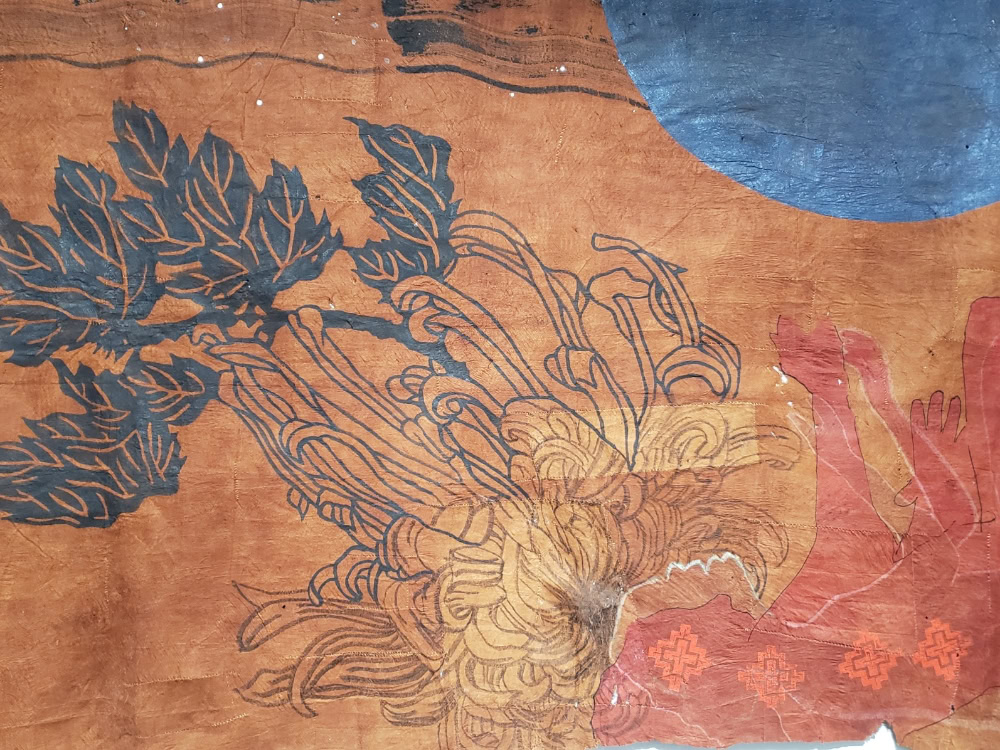
Hinton seems to embody this idea in Rest as Revolution: Wild Sage & Cygnus/The Swan. Hinton created this piece in 2024–2026. She used acrylic, Japanese ink, fabric paint and spray paint on African bark cloth. All of the bark cloth pieces combine a silhouetted image of a human body, which I read as a representation of Hinton’s body, with a healing plant and a constellation.
The idea that burnout (that exploiting yourself) perpetuates violence and that rest is revolution, comes from the same circles of conversation as Brown’s work. Healing yourself can be part of healing the world.
This idea also resonates with Hinton’s wall piece entitled 365: Macro-Micro Daily Ritual, January–December 2025. Every morning of 2025, with her coffee, and in the winter, with her SAD light on, Hinton made a small drawing thinking about the structures of cells. She adapted the practice from a writing exercise whose purpose was healing. The small drawings on cards take up the whole wall, arranged in blocks by month. If we do small things every day, the practice takes up real space.
Another composite of small works that depict enormous things, echoes this idea. Hinton took screenshots of recent pictures from the James Webb Space Telescope, as well as from other NASA sources. She printed them on a printer that uses mini-polaroids, hand-labelled them with a marker and hung them in a diamond shape.
In Cosmic Forces, 2025, Hinton brings a handmade, funky feel to these objects that are vast beyond imagining and invisible to the naked eye. She makes them into a shot of your bestie that could hang in your locker.
The sounds we make while speaking are closer to our bodies, but also invisible. Hinton has used images of the waves generated by pronouncing the letters of the English alphabet, cutting them out of wood with a laser cutter. Like her depiction of all the months of the year, the grid of these sculptural objects in wood follows the structure of the alphabet. You can identify the letters on the title card beside them.
In addition to these experiments, Hinton has painted large-scale works onto large, irregular rectangles of gorgeous russet bark cloth. Hinton first encountered this bark cloth when she was working and visiting family in Kenya and Uganda. It’s sustainably harvested from fig trees near the Nile River.
Craftspeople peel the bark from the tree, then soak it and beat it with mallets for weeks. Hinton bought six blankets and started to paint on them, but then stopped when she learned the cloth was used for shrouds and other ceremonial purposes. She held onto them, figuring she would gift them back eventually. But reaching out to do this, she encountered Elders who encouraged her to paint on them.
They want to get youth interested in this process. Ugandans want international artists to paint on the fabric to create a market for the product. Hinton encourages people to reach out to her who might be interested in purchasing some for their own artwork.
Onto these cloths Hinton works with her Ukrainian heritage, which includes painting and embroidering on cloth. She looks back to about 5000 BCE, when a matriarchal culture, in what is now known as Ukraine, maintained a period of peace for over 2,000 years. She told me that the Tree of Life pattern, often found in traditional Ukrainian arts and crafts, dates back to this period. Not being an embroiderer herself, Hinton cut printing blocks in the geometric versions of the Tree of Life pattern, and printed them into her paintings.
A plinth in the middle of the space supports headphones where you can listen to a soothing soundscape that complements the artwork. Jon Deline has input Hinton’s works into a computer program to generate sound. Nate Wood improvises harmonica over these sounds in a call-and-response style. The headphones rest on some of the bark cloth, so you are able to touch this interesting substance when you pick them up. The overall effect is profoundly peaceful.
At the exhibit opening, Hinton acknowledged the community who supported her in making these large works. Peter Menzies, at the Robert Service School in Dawson, allowed her to access the school woodshop, as a workspace, and taught her how to use the laser cutter. Colin Dorward and Victoria Parker, at The Warehouse, let her set up and work there in Whitehorse. She worked in the ODD Gallery between exhibitions. She organized a residency in Peter Heebink’s hobo cabin and large woodshop, as a working space out near Swan Haven.
Hinton’s solo show grows out of the web of Yukon art relationships, where she flourishes.
If you visit the Yukon Arts Centre, I recommend that you also set aside time to experience the Caribou Project, envisioned by Lianne Marie Leda Charlie, on display for the same time period. Outer Space — Inner Space: The Fabric of the Universe continues until May 22. The Yukon Arts Centre Gallery is open Monday to Friday from 10 a.m. to 5 p.m.