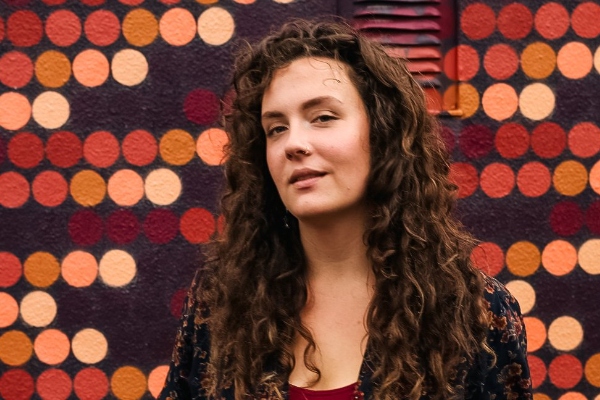
Nico Paulo was only two when she moved with her parents from Toronto to Portugal, where she spent her growing-up years.
“I had just graduated from design school in Lisbon and was looking for an internship. My parents said maybe I could take advantage of my dual citizenship. I was curious about it, too, so I moved to Toronto.”
It didn’t take long before being exposed to, and inspired by, her birth city’s lively musical scene led her to pursue her own musical interest as a career.
“Most of it is original. It’s funny, because growing up in Portugal, all the bands I sang with were mostly cover bands. There was definitely a discovery in Toronto, moving there and becoming a singer-songwriter.
With a father from France and a mother who grew up in Mozambique, she certainly wasn’t lacking in musical influences … European, African, North and South American (her native language of Portuguese gave her an entrée into Brazilian music).
While she doesn’t like to limit her options regarding genres she’ll attempt–folk, indie-pop, et cetera–she knows the feelings she wants to evoke with her current offerings
“The dominant feeling is definitely freedom, I think. Freedom, and healing. Those are the two things that I seek when I do it.”
About four years ago, some friends and a former partner persuaded her to travel to Newfoundland and Labrador, a region whose economic and cultural ties to Portugal date back centuries.
“The first time I visited, I fell in love with it. Not necessarily with the idea of moving there right away. But I really connected with the city of St. John’s. Just the landscape and the epic kind of coastline.
When COVID-19 hit shortly after that, she decided to stay there for a while. That was four years ago.
Although there is a huge historical link between Portugal and Canada’s East Coast, there aren’t a lot of Portuguese people in St. John’s.
“There’s not a big community, like Little Portugal in Toronto. And visiting Montreal, you see all the Portuguese shops and bakeries everywhere. Newfoundland doesn’t offer that, but people are nostalgic for it, and for the connection that they once had. So it’s nice to hear the stories.”
Since moving there, she has opened a design studio in St. John’s and been adopted into the city’s vibrant musical scene.
Paulo doesn’t come across as someone with an inflexible career path mapped out with military precision, but she didn’t let much grass grow beneath her feet before hitting a few major milestones in terms of public recognition.
Her self-titled debut album, recorded in a small cabin in southern Nova Scotia and released in April, 2023, was short-listed for that year’s Polaris Award in the folk category. It was also nominated for an East Coast Music Award (ECMA) in 2024.
She’s also not about to let early recognition become too distracting.
“I don’t think I take myself that seriously. I think I take things pretty lightly,” she says.
“The beauty of the self-titled record we released was that I really had no expectations at all. Of course, once you do it once, then you build some sort of idea of how it’s going to be next, how it’s going to be recorded, how it’s going to be sold, and whatever.”
While Paulo acknowledges that there’s definitely pressure with a second release, she isn’t spooked by the so-called “second album curse” that many young artists with early success can experience. In fact, her second album is well into the preparation phase now.
“I feel like if you keep practising, keep arriving at your desk and doing the work the way it feels right to you, that’s all you can do.”
One of the downsides of music recently, Paulo says, is “understanding that the industry is a little confused at the moment. There’s a demand to transition into completely online and digital, which is not as comfortable, I guess, a format. It still feels new to a lot of people in the industry.”
She admits to being a “bit of a resister” when it comes to submitting to others’ expectations, such as, “OK, now we have to have a TikTok account, or I have to have a Twitter account. It kind of comes down to I don’t feel like they are what I am, or that I really need them.”
One of the side-effects of early recognition is the expectation that a performer needs to get out and about, even if they feel most comfortable and productive in a recording studio, laying down tracks with other musicians, rather than sharing digital files from a distance.
Although Paulo acknowledges there’s “something beautiful” in the exchange of a live performance, she knows that constant touring can be “devastating” to a musician’s soul.
“Although I do love performing live, I think that if I had to choose one right now, I would do recording, because it’s more private. In my mind, it feels quieter.”
A good place to find Freedom. And Healing.
Nico Paulo will be onstage Thursday, Oct. 17 at the Klondike Institute of Art and Culture in Dawson City, beginning at 7:30 p.m. On Saturday, Oct. 19, she will perform at the Yukon Theatre on Wood St. in Whitehorse, sponsored by the Yukon Film Society.