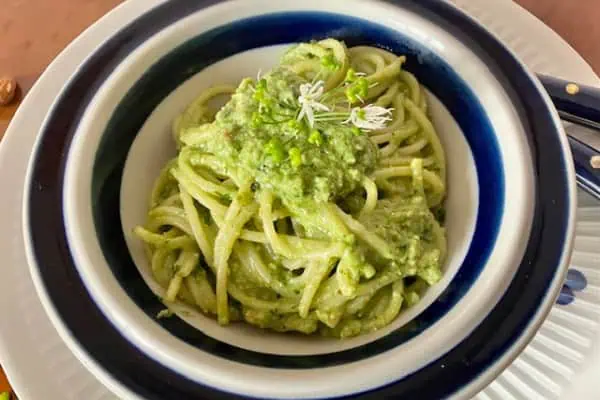
Nettle and Wild Garlic Pesto
Ingredients
- 2 cups raw nettles
- 1 cup raw wild garlic leaves and flowers
- 2 cloves garlic
- 1/2 cup raw almonds
- 1/4 cup olive oil
- Juice of 1/2 lemon
- 1/2 cup grated Parmesan cheese
- Salt and freshly ground pepper to taste
Instructions
- Wash nettle leaves thoroughly. Bring 2 cups water to the boil in a medium pot over high heat. Add nettle leaves, bring to a boil again, reduce heat and simmer until leaves are wilted but still bright green, about 3 minutes. Drain and plunge leaves into a bowl of cold water. Drain, squeeze excess water from leaves and reserve.
- Wash garlic leaves and flowers and reserve.
- Peel garlic cloves, cut off root end and place in the bowl of a food processor. Add almonds. Blend until mixture is the texture of coarse sand, about 1 minute.
- Stop the machine and add blanched nettles and wild garlic. Blend to a uniform texture, and with the machine still running, add olive oil in a steady stream, followed by the lemon juice, until thoroughly blended.
- Add Parmesan cheese, pulse to blend, and add salt and pepper to taste. Transfer to a covered dish until ready to use. Will keep in the fridge for up to one week and in the freezer for up to 6 months.
- Wash nettle leaves thoroughly. Bring 2 cups water to the boil in a medium pot over high heat. Add nettle leaves, bring to a boil again, reduce heat and simmer until leaves are wilted but still bright green, about 3 minutes. Drain and plunge leaves into a bowl of cold water. Drain, squeeze excess water from leaves and reserve.
- Wash garlic leaves and flowers and reserve.
- Peel garlic cloves, cut off root end and place in the bowl of a food processor. Add almonds. Blend until mixture is the texture of coarse sand, about 1 minute.
- Stop the machine and add blanched nettles and wild garlic. Blend to a uniform texture, and with the machine still running, add olive oil in a steady stream, followed by the lemon juice, until thoroughly blended.
- Add Parmesan cheese, pulse to blend, and add salt and pepper to taste. Transfer to a covered dish until ready to use. Will keep in the fridge for up to one week and in the freezer for up to 6 months.
Notes
Pesto Pasta
Ingredients
- 250 grams spaghetti or linguine
- 1 batch pesto
- 1/2 cup grated Parmesan cheese
- 1/4 cup pasta water
Instructions
- Add pasta to a large pot of boiling, salted water. Reduce heat and cook according to package directions.
- Once pasta is cooked, scoop out 1/4 cup of water and reserve. Place a colander or sieve in the sink and drain pasta. Return pasta to the pot, add the reserved water and stir in the pesto. Mix until pasta is evenly coated. Serve immediately, garnished with grated Parmesan and a garlic flower.
Notes
The woods were cool and green in East Ayrshire; the leaves, the fresh new colours of mid-spring
Blackbirds tweeted their melodious, full-chested song in the branches above, and curious robins hopped at our feet.
It was our first morning in Scotland, and my roommate and I were reacquainting ourselves with one of our favourite walks in Stewarton, a town of 8,000 about 40 kilometres southwest of Glasgow. Our guide was my roommate’s brother. He is a custodian of these woods, as a member of a local non-profit society that takes care of them. As we walked, he flung stray branches from the path into the bush, and regaled us with tales of battling the invasive giant hogweed.
The path we were on was once a carriage way for the people from the grand house on the hill, and these woods were part of their estate. They’re now the property of a nearby farmer and a beloved local park, patronized by dog walkers, runners, grannies with strollers, and little kids on bikes.
One of the great pleasures of walking through woods far from home is spying familiar plants. Under the beeches and the oaks, among the bluebells and the grasses, we spotted lungwort and our own fireweed, known as rose willow weed or bomb weed in these parts.
“My mother hated it,” said my roommate. “I think because it reminded her of the war.”
During the war and after, willow herb would appear in the disturbed ground of bombed houses, just as fireweed appears after a burn. As kids my roommate and his brothers were charged with going after the plant in the garden with a flamethrower.
A little further down the path we came across a patch of stinging nettles.
“Nettle pesto!” said my roommate. He made it once years ago in Whitehorse, after finding a patch of nettles in a downtown alley. He has since spotted nettle in several alleys, and has future plans, but nettle pesto has not yet reappeared on our table.
The deal was sealed when we saw a patch of wild garlic (Allium ursinum) a few steps later.
“We can add the leaves and flowers to your pesto,” I said, to a chorus of enthusiastic “Yes! Yes!”
Native to Eurasia, wild garlic has many names in the vernacular, including ramsons, buckrams, bear leek, and bear’s garlic. Folklore has it that the plant’s bulb was a favourite food of the brown bear, now extinct in Scotland, but still alive in stories and in the name of a beautiful edible plant.
We ate nettle and wild garlic pesto on our second night in Scotland, accompanied by garlic bread (why not?) and salad. It was one of the best pestos I’ve ever had. Yukoners will not be able to duplicate this recipe, but could come close with the first wild or domestic greens of the season, some garlic scapes or a few cloves of bulb garlic. Just stick to the proportions and you’ll do fine.
We’ve moved further north now, into the hills in the Cairngorms. I don’t know what plants we’re going to discover here, but I’m looking forward to finding out.