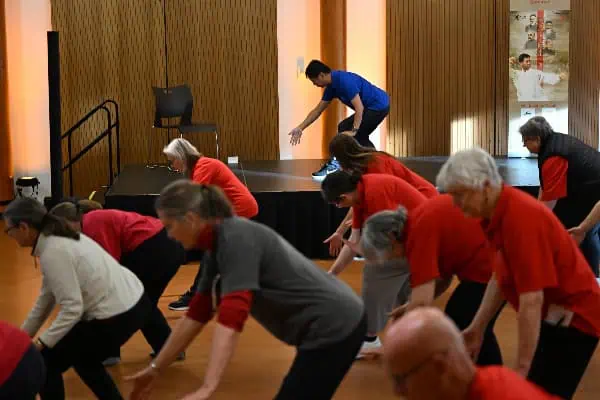
The most significant differences in the many styles of Tai Chi are in the speed and pace of the performance of the movements. There are also some subtle differences in the way the body holds the positions and different interpretations of the application of the movements.
As well, each instructor may emphasize certain aspects of the style thereby influencing its original intentions.
In the presentation to the public, some emphasize health benefits over martial training. Interestingly, it has been this approach with Yang style, as well as the willingness to teach it world wide, that has given it the biggest following.
Yang Style
Wider stances, back foot is generally at 45-degree angle with slow and gentle movements. Upper posture is generally straight.
The most popular Taijiquan in the world, it is recognized for its long form and meditative movements. Emphasis is on health and balance with many elder people using this form to continue a healthy and active life.
Wu: The Second Wu Style
Higher stances, parallel feet with slow and deliberate movements.
Spine completely straight and in line with the back leg. It has a very distinctive series of movements that characterize this form.
Chen Style
Lower stances, constant twisting and varying speed, soft and hard with varying expressions. Applications are taught quite extensively.
It is recognized as the first Tai Chi and many of the other styles are similar to it.
Weapons are taught and many believe it is the one style that has kept the emphasis on application in a martial arts context.
Sun
Smooth flowing techniques characterize this tai chi. It is a combination of three styles, Wu, Hsing-I and Bagua.
Hao/Wu (This is the first Wu style)
Its movements are slow and smooth and small while maintaining a high posture.
The one thing that is common among all of them is the internal principles and functions. As well, push hand techniques and weapons training is taught by all styles.
Competition
In 1956, the Chinese Sports Committee created the 24 simplified movements from the yang style long form. This was made possible for competition and judging to happen.
In 1976, they also created the combined 48 movements from Chen, Yang, Wu and Sun to enable more people to practise Tai Chi without having to learn the long forms from the traditional styles.
In the Yukon, only two traditional styles are presently being taught by the Tai Chi Association: Yang and Wu. There is also being offered the 24 movements that are derived from the Yang style. Information can be found at www.taichi-yukon.ca.
This article does not do justice to the deep and varied history of the varies styles, but I hope it encourages those interested to seek other sources for a greater understanding of just one of the many martial arts, Wushu, of China.