This is a big deal
After taking tai chi classes off and on for a few years, what would be different about taking classes from the Grandmaster himself?


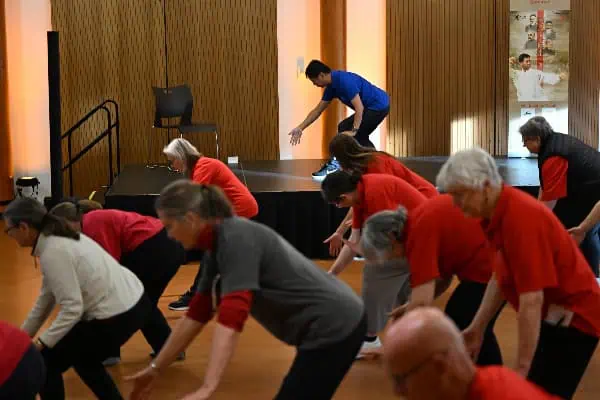
This tai chi Grandmaster visited once before, about 21 years ago, and I hear a karate Grandmaster visited about 37 years ago. Fifty of us lucky locals and visitors from elsewhere in North America got to experience what that means over the first weekend in October.
Here’s what I knew before Master Yang Jun arrived. He’s the fifth generational teacher in his family. He started learning tai chi chuan from his grandfather when he was just five years old. The two of them started teaching internationally, as a team, when Yang Jun was a young man. In 1999, his grandfather encouraged him to move to North America to continue the promotion of the Yang form of tai chi in the West. In 2009, the mantle of Grandmaster was passed from grandfather to grandson, when Yang Jun was in his 30s.
I was curious about this upcoming seminar. After taking tai chi classes off and on for a few years, what would be different about taking classes from the Grandmaster himself? And after practising tai chi with my classmates and local teachers, for one or two hours a week, what could we possibly do for five hours a day, three days in a row?
I knew there would be some culture shock for me. We students were given a list of protocols and procedures, which involved how to address the Grandmaster, how to ask questions and how to stand. I squirmed. But it turned out that Master Yang projects calm, good humour and flexibility. I stood in the right spot and babbled my required four words of Chinese, and it was fine.
The first morning, he spoke about so many big ideas—that tai chi is the philosophy; and tai chi chuan, the movement practice … and that it’s all about yin and yang, soft and hard, technique and strategy, understanding self and understanding other, about physical balance and energy balance. He used the image of water and I thought of how soothing water can be, yet how easily a wave can knock you down.
I loved watching him demonstrate. He embodied control and power, and clarity and groundedness. And when he showed a “normal” or “pedestrian” way of moving, we all laughed at the contrast. I guess we were laughing at ourselves.
That’s when I knew this wasn’t going to be just a movement class. This was going to go deeper into an invisible layer, to a place where mind and body and spirit work together.
Over the three days, we did work on the 103 movements of the long form. Having learned them in my local classes, I knew that they would take a presence of mind and concentration to perform. Feet positions, shifts of weight, rotations of the body, pathways that arms travel, and placement of hands, are very exact.
And each movement has a name. I love the animal ones: “white crane spreads its wings,” “repulse the monkey,” “embrace tiger, return to mountain,” “high pat on horse,” “part wild horse’s mane,” “golden rooster stands on one leg,” “white snake spits out tongue” and “snake creeps down,” which some teachers playfully change to “snake creaks down,” to describe how some of us older students do it.
Other movement names let you know that this is indeed a martial art: “parry, block and punch,” “twin fists strike opponent’s ears,” “turn body and chop with fist,” “right heel kick,” “left heel kick” and “punch to groin.” When Master Yang demonstrated (with a willing volunteer) ways that all of the movements might translate into serious and effective fighting techniques, we saw how the details of stance, body position, arm angle and hand shape make for powerful weapons. The teacher seemed to barely move; and the student, unhurt but surprised, was on the floor.
So besides refining my technique and expanding my awareness of tai chi chuan as a martial art, I experienced a pleasant culture-shock-worthy Aha! I saw that learning, rather than always going into new territory, can go over the same territory in a deeper way. It’s like peeling an orange to get to the juicy parts.
I appreciate Grandmaster Yang Jun and his work, around the world, to share the Yang family form and to collaborate with practitioners of other forms, for wider learning for all. Thanks to the folks who came from all over North America to join us in Whitehorse for a great weekend. Much appreciation to Pam Boyde, Yukon’s chief instructor who is also a director of the International Yang Family Tai Chi Chuan Association. And we are fortunate to have a bunch of really good local instructors and a great group of volunteers who helped make this event happen.
I am tired, mind-blown, and grateful.