




From Marcahuamachuco we continued heading south along the Andes, spending the night in Santiago de Chuco, the birthplace of César Vallejo (a great 20th-century Peruvian poet). Long days of driving led us to Cañón del Pato, where the Cordillera Negra and Cordillera Blanca mountain ranges converge. The Rio Santa flows through the narrow gorge and an even narrower road runs alongside the river, passing through 54 tunnels and winding its way past sheer rock walls, eventually coming to the town of Caraz in the picturesque Callejón de Huaylas.
We caught glimpses of the snowy peaks of Huascarán, Peru’s highest mountain, as we continued travelling through the department of Ancash. Heading farther inland, we arrived in Huánuco and then travelled southwards to Huancayo and Ayacucho. In Andahuaylas, we took a side trip to the stone forests of Pampachiri before finally heading back to Cusco via Abancay, after three full weeks on the road.
In a matter of a couple of days we enjoyed snowy landscapes high in the mountains, colonial towns surrounded by vibrant green scenery, as well as semi-arid countrysides filled with cactus-bearing juicy tuna (prickly pear fruit) in every colour imaginable. Peru’s incredible diversity was evident with every passing kilometre, not only in terms of its climate, but also its inhabitants. This last part of our journey included the following extraordinary sights.
Yungay / Huaraz
On May 31, 1970, an earthquake occurred off the coast of Peru, which triggered a debris avalanche originating on the mountain of Huascarán and buried the town of Yungay, killing approximately 20,000 people (only 400 survived). A giant cemetery and poignant memorial were built where the old town existed, and the new Yungay was rebuilt nearby.
About 50 kilometres down the road lies Huaraz, the capital of the department of Ancash, the largest city in the Callejón de Huaylas valley, and the jumping-off point for numerous adventure activities in Huascarán National Park.
Chavin
Located at the confluence of two rivers, Chavín de Huántar is a UNESCO World Heritage archeological site dating back to approximately 1200 BC. It was occupied by the Chavin culture and was believed to have been used as a ceremonial and religious centre. An incredible maze of tunnels and passageways exist below the monumental stone buildings and within the maze an intricately-carved granite stela (El Lanzón de Chavin). The Chavin National Museum located nearby has an impressive collection of artifacts from the site.
Huánuco Pampa
Huánuco Pampa was an Incan city built on a high plateau along the Qhapaq Ñan (Incan road system) between Cusco and Quito. Its ruins are spread out over two kilometres and include an ushnu (a large terraced platform), colcas (storehouses), residential districts and stone trapezoidal doors/gates.
Kotosh
Just outside of the city of Huánuco, in Central Peru, lies Kotosh, the earliest evidence of public and ceremonial architecture in the Andes. Said to date back more than 4,000 years, it’s also known as the Temple of the Crossed Hands (Templo de las Manos Cruzadas) because of two sculptures of crossed hands (one with the right hand over the left and the other with the left over the right).
Ayacucho
Ayacucho, originally named Huamanga, is known for the Battle of Ayacucho (fought during the Peruvian War of Independence in 1824 at the nearby town of Quinoa), the many years of Sendero Luminoso (The Shining Path) activity and bloodshed, as well as its 33 churches (said to be one for each year of Jesus’ life), which come to life during Ayacucho’s Semana Santa (Holy Week) festivities each year.
Cueva de Pikimachay
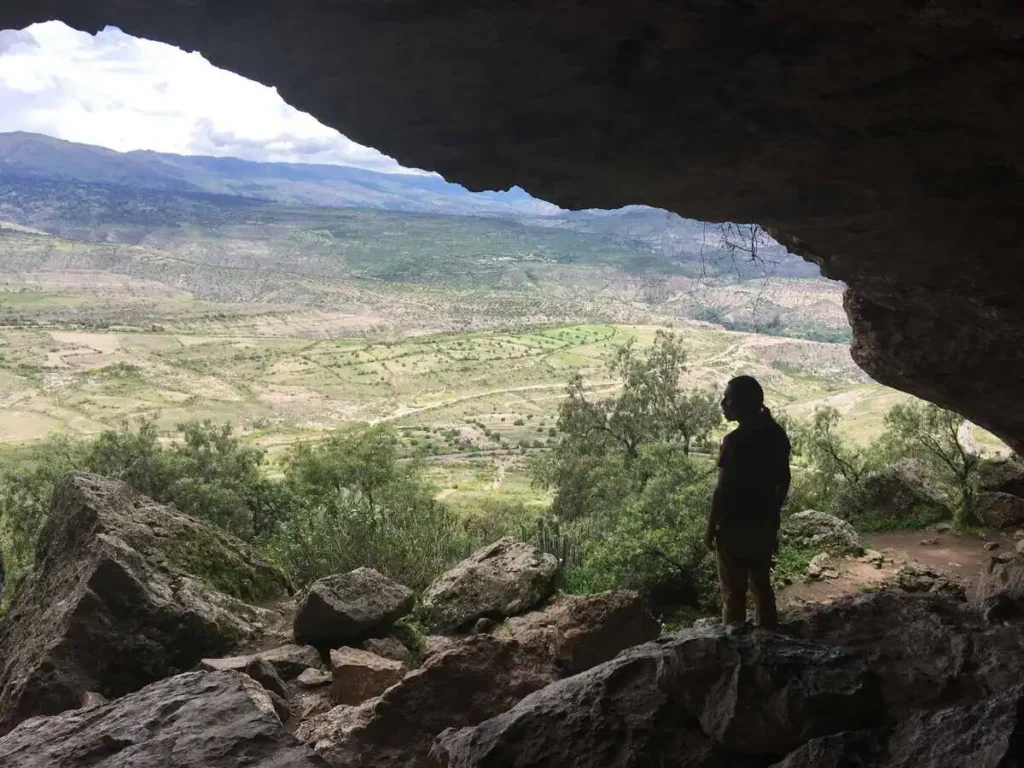
Pikimachay is an archaeological site in the Ayacucho Valley that is said to have had human presence more than 20,000 years ago (based on somewhat-disputed radiocarbon dating), but even more-conservative estimates support it being one of the oldest sites in Peru. A short hike leads up to the cave and its panoramic view of the Ayacucho Basin.
Complejo Arqueológico Wari
On the road from Ayacucho to Quinoa, the Wari Archeological Complex occupies an area of more than 2,000 hectares and was once the capital of the Wari civilization. The Pre-Incan Wari culture emerged out of the Ayacucho Basin between 500 and 600 CE and survived for about 500 years. The archeological site includes subterranean burial chambers that demonstrate impressive stone masonry skills, and a small on-site museum provides a brief overview of Wari history.
Andahuaylas / Sóndor
Andahuaylas, the homeland of the powerful Chanka culture, is a city situated in the Apurímac region (about a day’s trip from Cusco). Located not far from Andahuaylas, Sóndor is a pyramidal-shaped archeological site built by the Chanka people. Believed to have been a ceremonial centre, it offers astounding views of the nearby Laguna de Pacucha and the surrounding mountains.
Bosque de Piedras de Pampachiri
The stone forest of Pampachiri can be visited during a day trip from Andahuaylas. Located at over 3,000 metres, Pampachiri is filled with countless large cone-shaped rocks in an otherworldly landscape said to have formed millions of years ago after nearby volcanic eruptions. Some of these rock formations have been made into homes which have affectionately become known as Casa de los Pitufos (Smurfs house).
TarawasiThe last archeological site we stopped at, before returning to Cusco, was Tarawasi. Located in the district of Limatambo, Tarawasi was an important ceremonial centre built during the time of the Inca Pachacutec. Its ushnu (large ceremonial platform) is built on top of impressive stone walls that include the shapes of flowers in their design. The site is also said to have been used as a tambo (resting place) for travellers on the Qhapaq Ñan. A colonial hacienda was built at the site but is completely dilapidated now.


