How artifacts from the 1937 Mount Lucania expedition are being preserved
When Bradford Washburn and Bob Bates found themselves stranded on the Walsh Glacier in southwestern Yukon in 1937 with 900 lbs of food, gear, and photography equipment, they had some tough choices to make.
The duo had expected to attempt the first ascent of Mount Lucania as a party of four mountaineers and return to Valdez, Alaska, with renowned bush pilot Bob Reeve, using the glacier as their base camp and runway.
Washburn and Bates were on the first trip that June, following several gear caching flights in May. As the plane’s skis sunk into the glacier, it quickly became evident that the unseasonably warm weather had turned their landing strip to deep slush.
Reeve was stranded for days before the temperature cooled enough to allow for one of the most harrowing departures of his storied career. There was no way he would be returning with the remaining team members, or for Washburn and Bates for that matter.
Undeterred, the mountaineers recalibrated their exit strategy. Following a successful summit of Mount Lucania they would walk to Burwash Landing, covering almost 200 km of mountaintops and glaciers, thundering rivers, and tangled subarctic taiga.
Their survival was remarkable and possible in no small part thanks to the actions of local First Nation guides Johnnie Allen and Sam Johnson and wrangler Paul Bierckel, who the desperate mountaineers were fortunate to come across near the pass between the Donjek and Duke rivers.
All unnecessary food and gear had been left behind in caches on the Walsh Glacier, with the hopes of one day returning to recover them. But it wouldn’t be until 85 years later, in 2022, through the efforts of film production company Teton Gravity Research, University of Ottawa glaciologists, and Parks Canada specialists that the caches would be found and partially recovered.
Of the 53 artifacts found on the glacier, 21 were selected for removal, led by a Parks Canada archaeologist and conservator. The recovered artifacts were wrapped in wet cotton to keep them from drying out, and placed into labelled polyethylene bags.
Here is the conservation story of two of those artifacts in photos.
Fairchild F-8 camera lens and lens cone
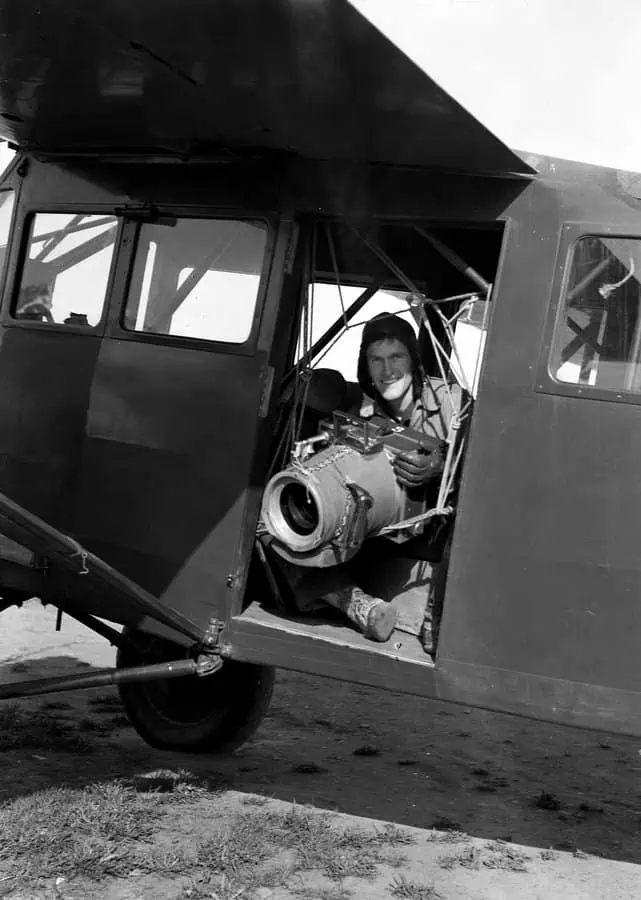
This photo, taken by Bob Bates, shows Washburn with a Fairchild F-6 camera. Washburn would fly with the door off, tethered to the interior of the plane to expose the large negatives and achieve his finely detailed mountain portraits.
Editor’s Note: Parks Canada has arranged a license for use agreement with the Boston Museum of Science for the use of the historical image of Bradford Washburn in the airplane with a Fairchild F-6 camera, labelled 57-2091 in their catalogue. This use allows for a printed What’s Up Yukon story and the online version of the story on whatsupyukon.com, it may not be used for any other purposes.

The recovery team, including Parks Canada conservator Cindy Lee Scott seen here with the camera lens, used warm water to carefully pour around the edges of the artifacts to free them from the ice. Where larger items were more deeply embedded, an electric chainsaw was used to cut channels around the sides of the artifact to pour the warmed water into. Chisels helped remove any last bits of ice the water couldn’t reach.


Partial ski and binding