
Yukon Rangers return from historic 5,200-kilometre patrol across the North


Three members of the Whitehorse, Haines Junction and Atlin Canadian Ranger patrols were welcomed home at the Whitehorse airport on April 13 following their return from Operation Nanook–Nunalivut 2026 (Op NA-NU 26), marking the end of a 54-day, 5,200-kilometre patrol by snowmobile across the Northwest Passage.
For Philippe Brient of Atlin, B.C., the return home marks another chapter in a long connection to the North. A Canadian Ranger with 1 CRPG’s Atlin Patrol, he joined fellow Rangers from across the North on this year’s operation. Over the years, Brient has taken part in multiple Arctic journeys, both on patrol with the Canadian Rangers and as family adventures alongside his family, including his wife, who is also a Canadian Ranger.
Operation Nanook–Nunalivut is an annual Arctic operation focused on readiness and cooperation across Canada’s North. This year’s operation included a 5,200-kilometre long-range patrol spanning the Northwest Passage.
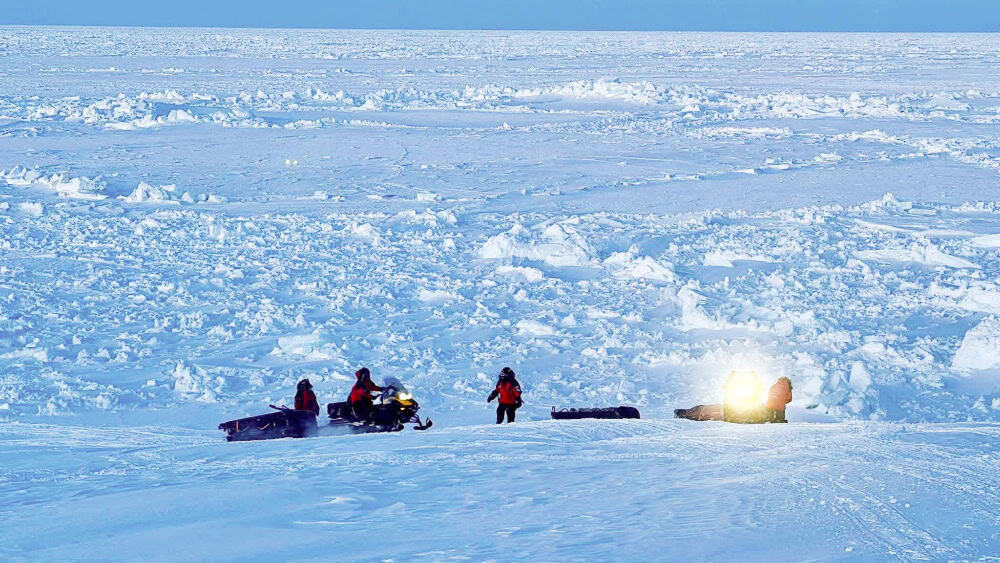
The patrol travelled by snowmobile west from Inuvik to Fort McPherson and Old Crow, then north along the Babbage River to the Arctic Ocean. From there, the team continued east across the sea ice to Naujaat on Hudson Bay, before heading south to Churchill, Manitoba.
The patrol consisted of a core team of 12 members, seven of whom completed the full 5,200-kilometre journey. But the patrol didn’t travel alone. Along the way, they were supported by a large command post team, fellow Canadian Rangers in northern communities, search and rescue technicians and the Royal Canadian Air Force, among others.
For Philippe, often serving in the role of the patrol scout, the experience was grounded in reading the land and moving with it.
Each day on the snowmobiles brought long hours exposed to wind and extreme cold. Navigation demanded constant awareness as the patrol navigated over snowdrifts, changing ice conditions, through whiteout and blizzard conditions. The weather could turn without warning at any moment. Progress depended on continuous decisions in terrain that often offered little margin for error.
The patrol worked long days in order to make progress. One of the most intense days included 16-hours on the snowmobiles, and travelling 320 kilometres.
One of the more difficult sections came between Old Crow and the Babbage River, where the patrol moved through mountainous terrain during a blizzard. Visibility dropped, winds increased and the land became harder to read with each passing hour. Progress slowed as the team worked carefully through conditions that required complete focus.
Later in the journey, while travelling on the Arctic Ocean, the environment changed again. The patrol encountered plenty of jumbled sea ice, requiring careful assessment and constant adjustments in route and pace.
From time to time, the team was able to settle into a rhythm across the ice. At just the right speed, they could “surf” the winddrifts. Going fast enough to smooth out the harshest bumps, but controlled enough to protect their machines and maintain safe travel.
Despite the difficulty and constant focus required, the Arctic revealed moments of scale and beauty. Long stretches of open landscape and distant horizons during the day, and endless aurora during the cold nights. For Phillipe, that sense of space is part of what continues to draw him north.
“I’m kind of drawn to it,” he said. “Those vast, empty places. There’s something about them that stays with you.”
Temperatures remained extremely low for the entire duration of the patrol. During 54 days on the land, the team faced more than 45 days of temperatures below -30℃ (without windchill). Blizzard conditions were recurrent, with the strongest winds recorded being 111 km/h.
The cold also made travel possible. Stable extreme cold temperatures supported reliable ice conditions in areas where, according to local knowledge, the ice had not fully formed in many years.
At the end of long days in the weather, the patrol camped in unheated tunnel tents, with heat coming only from MSR gas stoves, typically running for about four hours each day. Enough time to dry gloves, cook dinner and prepare breakfast the following morning.
The team had their systems well dialed in and performed consistently at a high level throughout the patrol. The tunnel tents proved to be a highly-effective and reliable setup, offering solid shelter even in the most demanding Arctic conditions.
Among the most memorable moments for Brient was being near sites connected to the HMS Terror in Nunavut. Being present in a place so closely tied to stories of Arctic exploration added another dimension to the journey.
“That part stays with you,” he said. “You’re moving through a place that’s lived through so much already.”
As the patrol moved south toward Hudson Bay, the landscape gradually shifted. Distance and isolation gave way to more communities, marking the final stages of the journey.
In Churchill, Manitoba, the patrol was met with a community welcome. For Brient, it was also a personal moment, as family and fellow Rangers were there to greet the team after weeks on the land.
“It was bittersweet that the patrol was over, but so good to see everyone again,” he said.
Over the course of the patrol, the team passed through 17 communities across the Yukon, the Northwest Territories, Nunavut and Manitoba. In each location, Canadian Rangers and local residents provided support, hospitality and assistance, reinforcing the connection between the Rangers and the communities they serve.
For Philippe and others on the patrol, the experience reshaped how they see the North. The Northwest Passage, often discussed in terms of geography or strategy, felt different on the ground—more active, more connected, and far from empty (but filled with the warmth of welcoming communities).
“You see how much is actually happening there,” he said. “It’s not empty. It’s different than most people think.”
Operation Nanook–Nunalivut continues to strengthen coordination, readiness and cooperation across Canada’s North.
As Philippe returns home to Atlin, the patrol settles into memory the way northern travel often does. Not as a single story, but as a series of moments shaped by distance, new friendships made, relations built and shared experiences lived.


