
Loving Labs, on or off leash

Have you ever talked to a black Lab? The raised ears, the head tilt and those big amber eyes searching to understand and relate, are memorable.
We have always had black Labs. My husband had one when he was a child. Those were the days when a dog could head out the door—no leash, no rope, not even a collar—and be known throughout the neighbourhood. That was in the 50s, on the outskirts of Edmonton.
When my husband and I and our three boys moved to a farm in rural Manitoba in the 80s, a male black Lab puppy joined the family. He was named Shadow. He was an outdoor dog with a custom-built straw-bale shelter, at first, and eventually a heated and carpeted wooden doghouse.
As a mature dog, Shadow weighed about 90 pounds. He was friendly to people and dogs within a few square miles of the farm, and he loved to go skiing with us. He did get into a bit of trouble by impregnating the neighbour’s bitch. (We remedied that by having the local vet give him a vasectomy.)
Eventually, the kids grew up and left home, Shadow died and we moved into the heart of Winnipeg. My husband wanted another black Lab, very badly. But as he travelled for work and I was often on call for my job, that didn’t work.
Then came retirement and a move to Whitehorse. Just prior to relocating, we found a family in a rural area, north of Winnipeg, who advertised “Labs for families.” We met our next black Lab, Sula, at two weeks of age and brought her home a few weeks later. She was with us when we made the move north.
We travelled with her in a crate and, yes, she was active, as puppies are, but it was summer and we were 15 years younger than we are now so that youthful energy was not a problem. By the time we settled in and bought a house, with a backyard gate that opened directly onto the green space, Sula had become a well-behaved dog. She was friendly to everyone, both humans and dogs.
She did tend to wander if she escaped from home, so she wore an electronic tracker. She was a beloved visitor at Copper Ridge Place and even found her way there on her own one day. We got a call to say that she had gone through the automatic door, signed in at the desk, put her paws up and received two dog cookies before she proceeded down the hall!
When Sula reached 10 years of age, we decided to get another black Lab—both to keep her company and so we would still have a canine companion into our late 70s and 80s. In May 2022, Sami (Prairie Storm Samantha) joined the family.
We assumed that Sami would be just like the other black Labs in our lives …
… but no! She was unusually wild as a puppy. We took her to training classes and waited for her to calm down … and waited … and waited. For her first few months with us, while she was teething, I wore leather boots to protect my ankles, as well as gloves or bandages on the backs of my hands. Cuts (those sharp puppy teeth!) and bruises adorned my body. Not the best for fragile (older) skin.
As we got to know Sami, we discovered that she was very different from our previous Labs. I call her “our neurodiverse dog.” She fears almost anything different or sudden, and her fear quickly turns into aggression. If an unknown dog comes up to her suddenly, Sami’s hackles are up and aggression ensues.
Although we walk her in the green space where most dogs are off leash, she must be tightly controlled and always on a leash. We took her to several training sessions and even had sessions with a private trainer. All of this pointed to diagnosing her as a non-social dog.
With people, she is fine—especially if the person is female, and even more so if that person has dog cookies. She will snuggle up to the person and even roll over onto her back with her legs in the air. Sami loves our granddaughters and is the most affectionate dog we have ever lived with. She always wants to be close to one of us, preferably in actual physical contact with us. This can make my knitting or keyboarding very difficult with Sami poking my arm or draped across my lap.
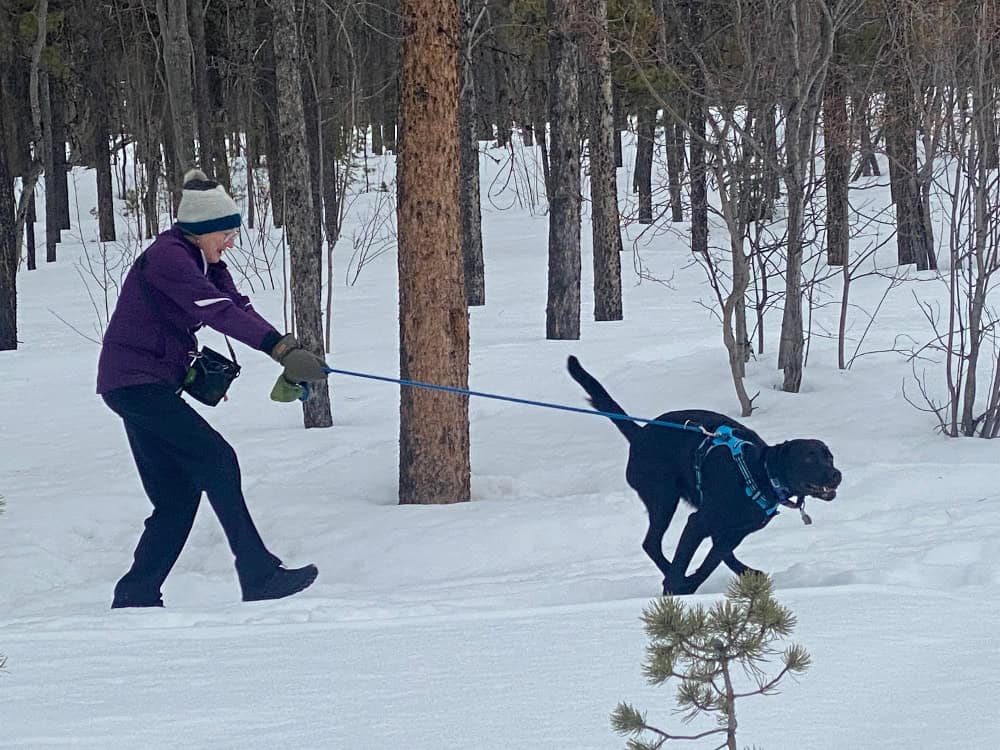
It is reported that living with an animal can improve health, cognition and mood. The physical contact is wonderful but, for a couple of seniors (first with a crazy puppy and now with an active “special needs” dog), things can be difficult and even dangerous at times. Being dragged along the trail or sidewalk at high speed is scary. I’ve seen photos of an elderly woman hanging on for dear life, with a leash at full extension, and barely keeping her feet on the ground. I fear that is sometimes what I look like. Fortunately, none of my falls have been serious and no broken bones. But that is a risk with an active, athletic dog. Sami is now four years old and is perhaps beginning to calm down. I can’t imagine life without her!
I think if we ever get another dog, it will be one that is past the puppy stage, with its character already in evidence.


