
And yet, there’s so much more to the story …
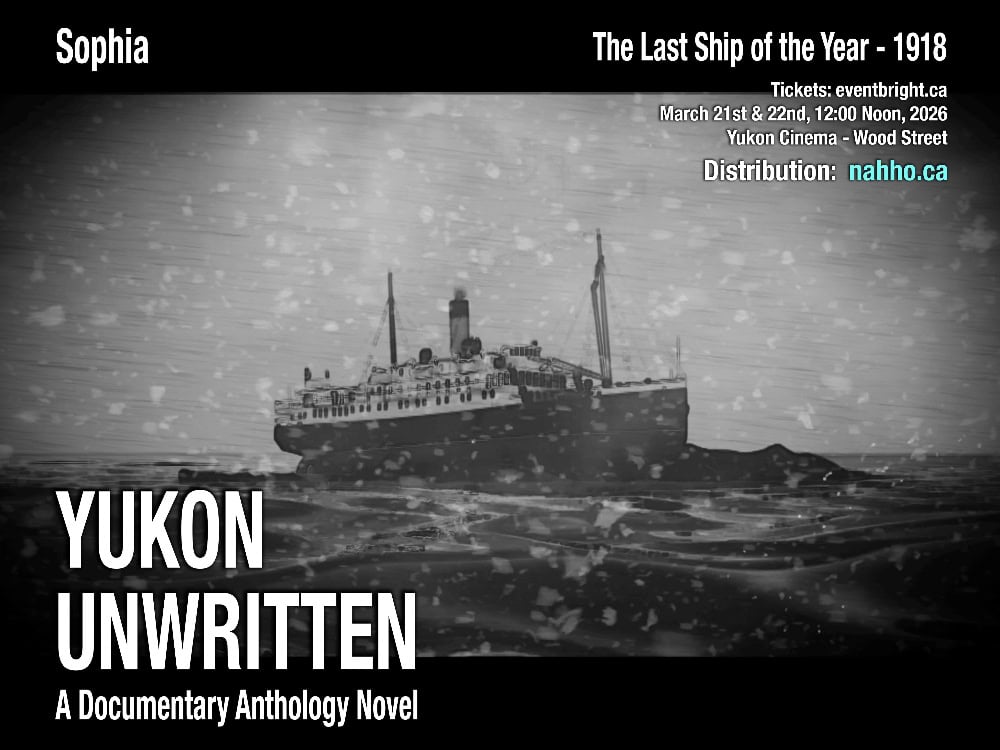


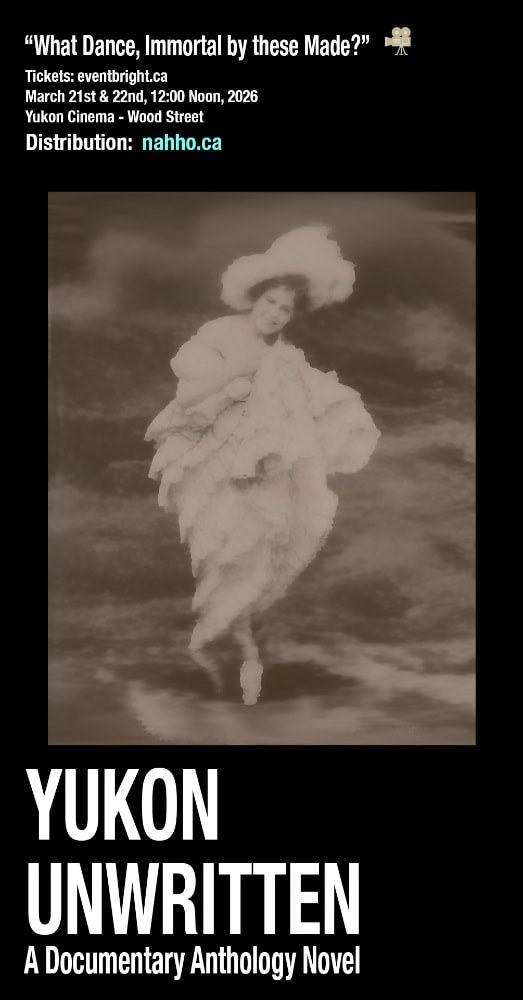

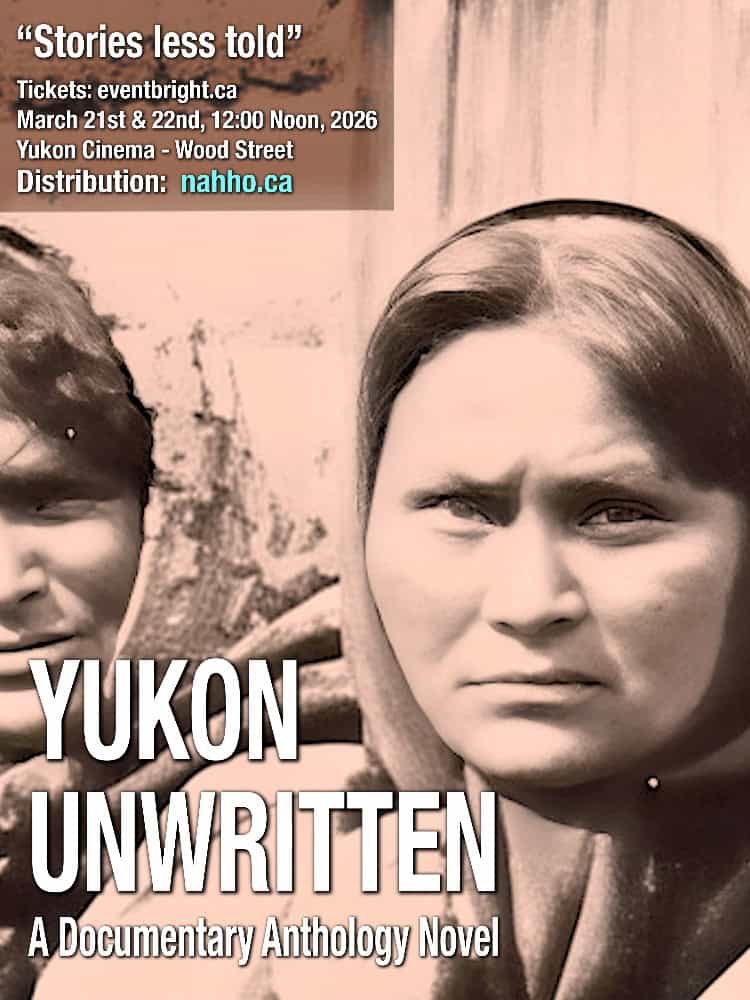

Yukon Unwritten—created by NahHO! Productions, based in Northern Canada, written by Allan Code, Bayne Orion Bradshaw and Mary Code—takes viewers from Ice Age Beringia through the brutal realities of the goldfields and beyond. With stories that flow from the land, unfolding through the eyes of its Traditional custodians and new arrivals.
“We are part of a bigger and older world than people imagine. And science agrees with much that we already know,” says Allan (“Al”) Code, director of Yukon Unwritten.
Yukon Unwritten may be viewed as a feature Documentary in 16 linked chapters, each between six to 17 minutes in length. It is like a non-fiction novel to be devoured in a single session, or over the course of many sessions. For streaming, broadcast, public meeting, lecture theatre or classroom, each story focuses an audience’s attention on the subject.
Code says Yukon Unwritten was made with Canadian federal support, to commemorate the 125th year of Yukon as a territory of Canada. He adds, after writing his original project treatment, that nothing could be further from the truth; and thinking that would be the end of the project, he discovered there was an appetite for the stories that he proposed to tell.
“Fractured stories of a fractured history,” Code says. “Some of the stories in Yukon Unwritten go back 24,000 and 36,000 years ago, when much of Yukon was ice-free and connected to Siberia, Asia and Europe as a contiguous land mass joined by the subcontinent of Beringia (not a [land] bridge).
“A hunter just east of the MacKenzie River could go on a walkabout to Spain or Norway, with plenty of big packets of fast food (mammoth, bison, caribou and moose) along the way. This was a cold, dry Serengeti of a grassland—big like the world has never seen.”
Like the intro to the film’s media release, the theme of Yukon Unwritten is to shine a light on the deeper and less seen and understood histories of the territory.
“Our approach was to get our stories far away from textbook ‘history’ and colonial obsessions of the written record. We chose to develop our perceptions and connections beyond the written word. Much of our research came from observations of the land itself,” Code says.
Code adds, today, that history is written in “isotopes and fragmentary DNA” and that the stories these research methodologies tell are deep, involved and exciting.
“I saw Yukon Unwritten as a way to see history free from textbook assumptions that start with late 19th-century newspaper misinformation and hype that were ultimately spun into written and popular ‘history’ of Yukon. We leave that stuff to politicians,” he says.
Code also says that, with this ambitious project, he’s grateful to those who study and preserve real Yukon history—people like Testloah Smith, Kaska Knowledge Keeper; and dedicated historians like Ken Coates.
“Their expertise has helped keep this project on track,” Code says.
Code points out that Yukon history is not just a story of human adaptation and adventures. He says it is, rather, “a story about the land and our relatives who live upon it. It is about the caribou who are the key to sustainable existence here, and [about] the fish in these rivers.” He adds that to really live in the Yukon is “to be connected and respectful to our Mother. We are part of an eternal reciprocal relationship with an encompassing nature within which we live.
“A nature to have dominion over is impractical in the planetary long-term, as our societies are finding out,” he says.
Yukon Unwritten is an experiment in form, says Code, adding that it’s like a non-fiction, chaptered novel where the five- to 17-minute chapters (14 in all) form an anthology in the sense that Barry Lopez’s Arctic Dreams is an anthology.
“Yukon Unwritten chapters are joined by recurring musical themes and a persistent irreverence for histories we have been indoctrinated to accept,” Code says.
Code also says that with the feature documentary, viewers are informed by actuality and visual record, primarily. There is no stock footage, he adds.
“Our team shot the footage you see. This footage represents years of often cold and patient work.”
In the end, Code points out that there are many revelations in the territory that remain unwritten.
“Conventional Yukon history leans towards an ‘outsider’ perspective,” he says. “Adjectives like hostile, frigid, forbidding, unforgiving, etc., have no place in Yukon Unwritten.
“People live here happily. Many groups of people have been living in these places and these latitudes for many, many thousands of years. Frontier? Be serious!
“See the images and hear the words of people much wiser, insightful and more experienced than I am,” says Code. “This anthology is a feature documentary (or a series) 113 minutes long that just might be a good beginning for a Yukon history yet to be recorded.
“It is written, shot and edited in Yukon. The process took most of two years. We are delighted to share Yukon Unwritten with you at the premiere.”
Yukon Unwritten runs March 21 and 22 at the Yukon Theatre on Wood Street.
Visit nahho.ca for more information on the film.


