
In the realization of a decades-old dream, musician and producer Matthew Lien and singer Diyet van Lieshout have achieved a monumental feat for Yukon music
“I wanted to celebrate that amazing wilderness, which I felt was unknown outside of the Yukon”

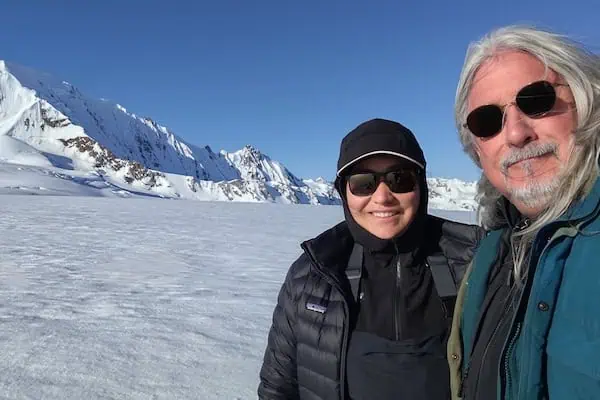


Forty years ago, Matthew Lien felt like he had failed. The Yukon-based musician, composer and producer had the idea to transport a full-sized piano into the Kluane Mountain Range to create a monumental piece of music honouring the culture, scenery and artistry of the north.
But everything he wrote musically just seemed to fall short of his vision. It got to the point that Lien made the difficult decision to shelve the project, but his desire to bring it back to life never left the back of his mind.
“I wanted to celebrate that amazing wilderness, which I felt was unknown outside of the Yukon,” he explains, outlining his plan to record a video involving a grand piano being played on King’s Throne Peak.
“Lots of people were excited about the idea. I got a letter of support from Parks Canada and I received a letter of support from the mayor and council of Haines Junction. I applied for $5,000 for the recording of the song, and accomplished that, but for several reasons, the song did not meet my expectations due to my own youthfulness and lack of experience.”
It was such a disappointment to Lien that he thought his career was over. Though the song his idea spawned at the time, “Kluane,” would go on to be well-received, he knew it wasn’t the right song for his grandiose vision, but he wasn’t sure he had it in him to truly bring his ultimate dream to fruition.
“I kept the idea in my imagination over the following decades,” he says. “As a dreamer, I imagined what it should really be is something called “The Kluane Compositions,” and it should feature three movements, representing the ice fields, the glacier forefields and the front ranges, which are really three distinct personalities of Kluane.”
Lien also realized that to truly work, the project would need an indigenous collaborator. There was one obvious choice: local singer-songwriter Diyet van Lieshout, a prolific and well-known musician who is also a member of the Kluane First Nation. Eventually, Lien had it all planned out. It was all coming together, at least in his head, should the opportunity to take another stab at the project ever present itself again. Finally, in 2024, it did.
“The Yukon Government was looking for projects to celebrate the 125th anniversary, and when I heard about that, I called Diyet immediately,” says Lien. “We both grew up at Kluane, but I am from a family that moved here, and she’s Indigenous, so we will forever have different perspectives of that place.”
When Lien presented the project proposal to Diyet, she loved the idea and was eager to put her own stamp on it.
“I got a call out of the blue from Matthew,” says Diyet. “He pitched this idea to me of composing new music, filming in the Kluane icefields and slinging a grand piano out there! I was super intrigued and I could visualize how that would look immediately.
“The more that we talked about this idea, the more I saw the significance of connection, conservation, understanding, and how land, words and music can be the foundation to tell an important story.
“Both Matthew and I are passionate about Kluane and we are passionate about storytelling that’s grounded in the connection of humans and land.”
The project was selected as one of three recipients of the Yukon 125 prize, along with Yukon Alpine Climbing for the first ever ascent of Radelet’s Peak and Tedd Tucker and Amy Kenny for “It’s Weird Up Here: A celebration of small achievements,” a written and illustrated account of undertold Yukon stories.
The three movements of The Kluane Compositions became a 13-minute film, one Lien says is a downplay to call a music video.
“My role is that of an observer, and Diyet’s is the spirit of the water, the spirit of the land,” Lien says. “In the beginning, you see we’re never in the same frame; we appear to be in different locations, perceiving a different angle.”
Throughout the second movement, the two characters draw gradually closer together through some of the harsher glacial landscapes of the region, and the third movement flows with a feeling of harmony, giving a truth and reconciliation undercurrent to the story, in a way Lien says is more meaningful than he could have imagined.
For Diyet, the film has also proved to be a way to send a message to viewers and listeners about climate-related issues.
“A big part of this work is to draw attention to ice to climate to human impact to truth telling and understanding,” she says. “Our territory is one of the last places on Earth where we can deeply connect to an ancient world while simultaneously living in a very modern one.
“But our planet is rapidly changing, and much of that impact is caused by us. We want Yukoners to feel that passion and compassion for this incredible landscape that we get to live in and take care of.”
After a lengthy collaboration period between the two musicians, the music, lyrics and film were written, but there were still some things that needed figuring out. Logistically, this was a very difficult project to pull off.
The thought of using a helicopter to get a grand piano — and it had to be a grand piano — into the Kluane Mountain Range left Lien at times wondering if he’d bitten off more than he could chew, but he had come too far this time to turn back, and had the support of his excited and proud community behind him.
“Out of respect to the potential of what this should become, it required a number of shooting days and locations, and I’d have to undercut myself as an artist and a visionary of we were to restrict ourselves to a scope that only the government’s funding would have accommodated,” says Lien.
He admits having to sell a home to prevent bankruptcy in order to fund the project. “The first day of flying in the piano, even the pilot wasn’t sure if it would play nice in flight.”
Lien considered using a smaller piano, or a keyboard that fit into a grand piano prop, but those options just didn’t feel right — after all, the thought of getting a grand piano into the mountains was a huge selling point of the project, and Lien felt anything short of that would be cheating. The final result is Lien’s decades-old vision finally brought to life in a befitting way.
“You can imagine, 40 years later, to sit back and watch it and listen to it and have just met the mark in every way — I am just completely satisfied and thrilled with the result,” he says. “The excitement now is to share it, because as a creator, that’s always the endgame, is releasing something you believe is inspiring and hopefully seeing it ignite inspiration and passion.”
Yukon Minister of Tourism and Culture John Streicker is one of many who has praised the project, calling it “bold” and “imaginative,” and saying it “succeeds in interpreting and commemorating our shared Yukon history through an entirely unique medium and perspective,” while also commending fellow Yukon 125 prize recipients.
“The concept for The Kluane Compositions was certainly staggering in its ambition,” he says. “Matthew and Diyet’s dedication to their vision was unwavering, and the beauty of the final product speaks for itself.”
The Kluane Compositions will be publicly premiered at the Yukon Visitor Information Centre on May 27 and will be available to view online afterwards. To keep up with Lien, visit matthewlien.com and to keep up with Diyet, visit diyetmusic.com.
“These projects highlight the depth and diversity of who we are, and they show how culture helps connect us to each other, to our stories and to the places we call home,” says Streicker.“The 125 prize has been an opportunity for Yukoners to achieve something extraordinary, to showcase the North and to highlight the Yukon’s spirit of adventure, artistry and innovation.”
[Ed. Note: The video will go live on May 27th at 9 p.m. YST. You can tune in here: https://youtu.be/Tn9DUBlM3SU?si=ye-Zq9f02hp8KTjp ]


