Reader Submission by Erin Neufeld
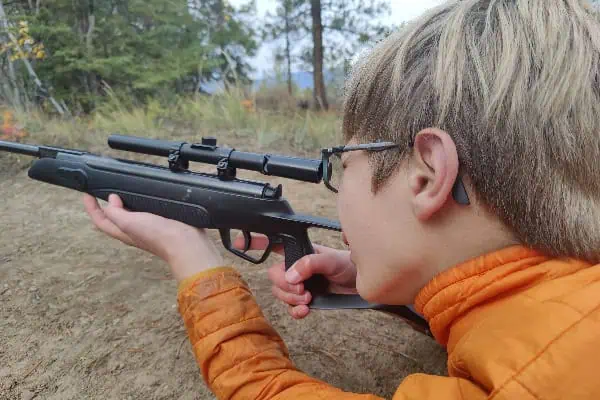
I admired the way my son carefully walked with his gun, managing the muzzle to ensure it was never pointed at anyone, or the dog, with the safety always on
Erin Neufeld

We awaken to a world touched by Midas—the aspen trembles with golden rays, and the sunbeams slant through the pines in gleaming shafts of light. The air prickles with thoughts of snow, carrying that heady aroma of ripe berries and decaying leaves. It is autumn. Time for berrypicking, harvesting the garden, and—this year (for the first time in our family)—hunting.
When my son turned 10, we gave him a gun, a Stoeger Airgun .177 Air Rifle. He shot beer cans and paper targets. Once, after Halloween, he shot the pumpkins after they’d done their dash as jack-o’lanterns. It became a weekly activity, through the winter and into spring, to compete with his siblings and us, to see whose aim was improving (his) and whose was not (mine).
Neither my husband or I had come from a hunting family. We both ate meat and had our experiences with raising and harvesting chickens and turkeys, but we’d never gone out and harvested wild game. It was something that interested us—the opportunity to be out in the environment, observing the world around us, increasing our food security by providing for ourselves and, most importantly, teaching our kids about the need to care for our planet and all the creatures that live within it, by respecting and caring for the world around us. We saw hunting as a way of connecting with our place, sustaining ourselves and teaching our children. But we didn’t know where to start.
We decided that, despite falling outside the required age for taking the Hunter Education and Ethics Development (HEED) course, offered by Environment Yukon, we should probably start there. Taught by Jim Walsh, the course looks at basic gun knowledge and safety, animal identification and the territorial rules and regulations around hunting various game animals, as well as the importance of hunting in an ethical way. Filled with stories of his own and friends’ experiences, Jim Walsh provided an entertaining and engaging evening. And despite the three-hour length, he kept our 11-year-old son entranced. We all managed to pass the final exam at the end. This course, combined with an online component, gave us the ability and confidence to go grouse hunting with our son’s air gun.

My husband and son began going out for walks each evening and morning, before school, with the gun.
They would wander quietly through the forest, listening for the quiet chuk-chuk of a grouse, stopping to orient themselves to it, every so often, and making sure there could be a safe shot taken from the angle of approach. Sometimes I would join with our other kids and the dog, and we would all try to quietly listen and look for any signs of the stealthy “forest chickens” … only to have the dog bound into some nearby bushes and flush out a trio of birds that would all fly off in wide arcs to land on nearby spruce trees. We all really enjoyed this new way of walking, often off the normal trail, and really actively listening to the world around us.
It’s amazing how I’ve walked these trails for decades and have never seen the places I have since taking up hunting, or at least walking around with a gun.

One afternoon, after a couple of weeks of twice-daily “hunts,” we were on our way home, after following a grouse from tree to tree, through the forest, until it had lost us in a dense bog of black spruce. I admired the way my son carefully walked with his gun, managing the muzzle to ensure it was never pointed at anyone, or the dog, with the safety always on. He answered his younger siblings’ questions about the gun and had his eyes and ears on the forest around him
It was a really proud moment for me to witness his learning in action, and his earnestness at learning a new skill. He was walking out front on the trail, while I hung back with his siblings, when he stopped and slowly backed up. He looked back and signalled for us to stop. He had seen something. We all quietly stopped on the trail and looked to see what he had seen. I took a couple of careful steps forward to find the grouse, and there it was, standing right at the junction of the trails—head up, feathers out, chuk-chuking to itself. I whispered to my son to be mindful of the hill behind the bird, and he dutifully crept through the bushes to take a safer shot. He carefully sat down, then laid on the ground and lined up his gun.
I watched him take a breath and then ease it out, and all of a sudden the bird was a ball of fluff and feathers on the ground. I quickly walked over and made sure it was dead (my son has taken that shot so many times and then watched as the bird flew off, startled by the noise). This was his first hit. His first success. His first kill. And I could see all of that “shifting” across his face—pride, happiness, confusion, and sadness.
The kids and I gathered around the bird and gently put our hands on it. We said thank you to the forest—and to the animal, for giving its life, and we promised to treat it with respect. My husband was coming up the trail to us, and the kids all ran off excitedly to tell him about the grouse. On the way home, my son wanted to carry the bird and to help his dad clean it up and put it in the fridge. I pulled out some recipe books and we looked through them together, then settled on one of Miche Genest’s recipes for cooking it.
At bedtime, our son was sad. He couldn’t stop thinking about the grouse and how he had killed it. So we talked about how that grouse had had a wonderful, happy life, right up until it died, and how we would be careful to use as much of the bird as we could, to be respectful of the life it had given us.
My husband asked if he still wanted to hunt. Our son thought for a bit and said, “Yeah … but maybe not tomorrow.”
Erin Neufeld grew up in Whitehorse, where, after 15 years living in Aotearoa, she has returned. She lives with her husband, three children, and various animals. She loves exploring the world around her and learning about the connections that make us who we are.