Faro’s unique history tells a tale of transformation, resilience and a lasting sense of community
When staking began, the claims were named alphabetically and the sixth claim — the Faro claim — was the winner


The Town of Faro has a “weird staying power,” according to long-time resident Katy Peeling.
Peeling has lived in Faro for over 50 years through the community’s boom-bust cycles. She calls it a “serial community,” meaning that it has changed and reformed many times, and it keeps going. Each new community that forms has had a “different character and personality,” she says.
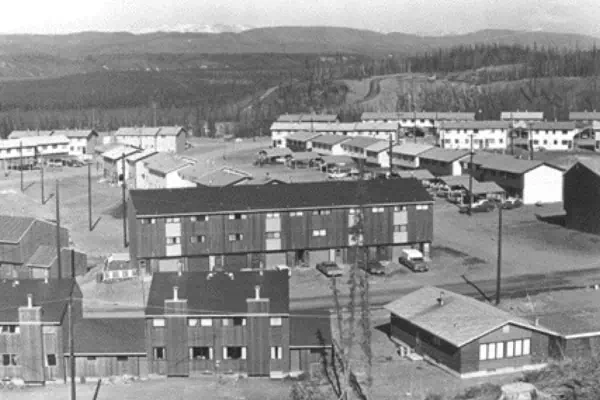
Faro was first created as a home for workers at the Anvil (later, Cyprus Anvil) open-pit lead-zinc mine. The mining company built the town’s infrastructure — many different types of houses, a school for grades K to 12, a medical centre and recreation facilities.
“When staking began, the claims were named alphabetically and the sixth claim — the Faro claim — was the winner,” says Peeling. “So, they named the new town after the discovery claim.”
In July 1968, the Yukon Territorial Council agreed that the townsite would be named Faro, also for the card game in which players bet on card order, in the hopes that Anvil would “hold a winning hand,” according to the Whitehorse Star.
The Faro mine area is located on the traditional lands of the Kaska Nation and is known as Tse Zul to the Ross River Dena for the “hollow rock” found there.
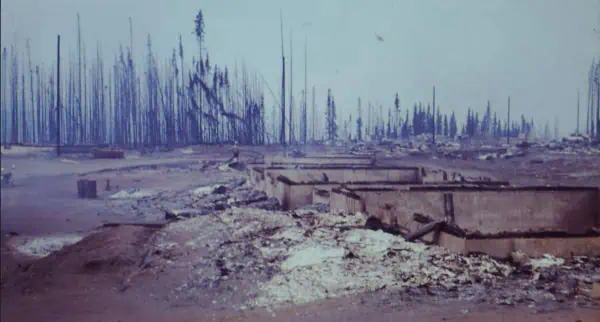
Shortly after construction began in June 1969, a lightning-caused fire destroyed most of the town. Just two houses and two maisonettes on Ogilvie Cres. were left standing. Undeterred, the mining company rebuilt, and by September people were moving into homes in Faro.
In 1974, Peeling and her husband came to the town in a Chevy pickup with their own home-built camper on top. They left again in ’75 because there was not enough housing. Friends encouraged them to apply for work at the mine, so they came back and stayed.
Over the years the town grew to over 1,600 people, and there were lots of activities to keep them busy, including a slate of hockey leagues, an annual curling bonspiel called the Sleeping Bag, and Farrago, a music festival that pulled in bands from across the country.
With major expenses, such as housing and groceries, subsidized by the mining company for mine workers, it was a golden age in the community.
“It was so much fun to be in the community at that time, but everything at that period was,” says Peeling. “People were involved in the community. In a small town, if you want something to happen, you have to pitch in and do it right.”
In 1982, mineral prices plummeted, causing mines throughout the Yukon to struggle, and Cyprus Anvil to close temporarily. When it reopened a year later, workers came back to the town, but the community was different.
Peeling remembers it being difficult to describe how vibrant the town was before the first shutdown. “We tried to explain to the new people coming into the community that we did this, that and the other, and they said, ‘Oh no, you couldn’t do that in such a small town.’ But we had a local newspaper, for instance, that came out every two weeks and they didn’t see how that could happen.”
The mine closed again in 1985, and the town’s population plunged to 400. There were efforts to open the mine again in ’86 and ’96 that were successful for a few years before the site was finally shuttered to active mining in 1998.
Today, it is one of the “most complex abandoned mine clean-up projects in Canada,” according to the remediation project’s website.
Faro was one of the last mine sites in the Yukon that constructed a town, rather than a camp, to house employees. And unlike other mining communities, the town of Faro was able to continue after the mine closed.
In the early 2000s, Faro set out to grow its economy by increasing tourism. They built the Campbell Region Interpretive Centre and the Faro Golf Course, which runs through the town. The Crane and Sheep festival and the Faro Golf Tournament have become annual highlights, drawing visitors to the community.
Now, working alongside the town’s administration and community members, the Yukon government’s Historic Sites Unit (HSU) is determining which of Faro’s buildings to include in the Yukon’s Historic Sites Inventory. The inventory is an online database of more than 4,000 built sites that have cultural or historical significance, such as buildings or bridges.
To make the list, a building needs to meet a few key criteria: It must be over 50 years old, retain its original character — meaning that it has not undergone major alterations — and have significance to past, present or future generations. The HSU staff have started conversations with community members in Faro to find out which sites are important to them.
Faro has some historically significant buildings, such as the theatre, which was built in 1966 near Cobalt, Ontario. It was moved to Faro in 1971 to provide a space for more entertainment and cultural experiences in the town. There are also buildings that could be significant because they represent a certain time in the community, such as the different types of prefab housing built through the years for mine workers and their families.
The inventory is one tool that HSU uses to manage heritage sites in the territory. It includes a record of almost 50 years of documentation for sites scattered across the territory — from actively managed sites such Fort Selkirk — which is co-managed with the Selkirk First Nation — to hundreds of relic sites in the Klondike Gold Field, to the remains of Norwegian explorer Roald Amundsen’s winter cabin on Yukon’s North Slope.
Once a site is listed in the inventory, it may also be considered for further protection, preservation, and education to ensure its historical and cultural value is recognized and maintained for future generations.
What’s next for Faro?
“I think we’re all trying to figure that out,” says Peeling. “I feel so grateful for having watched it over the past 50 years. It’s a long time, and I know it will all come out right in the end.”