Lacto-fermentation
At minus 50℃, growing root vegetables is not an easy thing. In the Yukon, while the growing season in the summer is very efficient, with almost 20 hours of daylight, the winters are tough for our food gardens.
To keep eating local during cold months, with very little energy and time required, lacto-fermentation is a fantastic solution for preserving fruits and vegetables, among other foods.
Preserving veggies for years (in salt and water)
Since the Neolithic Age, the process of lacto-fermentation is well-known. The idea is to preserve food in salt or a brine (salt and water), in an airtight container. The salt allows the produce to stay firm and helps to accelerate fermentation.
In those conditions, fermentation will start producing lactic acid, thanks to lactic bacteria that is naturally available in veggies. These bacteria multiply, feeding on food sugars (carbohydrates). The acidity produced destroys any pathogens or bacteria and avoids risk of food decomposition or alteration. Once fermentation is done, food can be kept for years at room temperature.
In addition to preserving, fermenting has other benefits. The process keeps vitamins in the fruits and vegetables and even increases their levels. The food is also easy to digest and strengthens our immune system.
Beyond health benefits, lacto-fermented products are delicious, cost saving and super easy to make.
So what are lacto-fermented products? Sauerkraut, pickles, kimchi or any veggies or fruits in a brine; but also ham, salami and some fishes such as Nước Mắm (Vietnamese dipping sauce) and smoked salmon (salted before being smoked).
Salt or brine?
Use salt for veggies that have high water content (1% salt for the veggies weight, cut into small pieces). You will see the brine appear naturally. For whole veggies or low-water-content ones, immerse them in a brine (3% salt to the water volume).
Here are several recipes to get you started!
Baba Ganoush
Equipment
- 1 glass jar (500ml/18oz)
Ingredients
- 2 to 4 eggplants
- 2 garlic cloves cut into 4 pieces
- 2.11 cups 18oz of water
- A Tbsp sea salt
- Olive oil
Instructions
- Peel the eggplants, cut them into slices and then in half again. Place them into a colander and sprinkle with sea salt. Leave for one hour (the water will come out).
- Prepare the brine: add the salt to the non-chlorinated water.
- Once ready, press the eggplants in your hands to remove excess water.
- Pack them into the jar, with the garlic and any aromatics you like (oregano, parsley, etc.).
- Pour the brine overtop.
- Seal the jar and leave it to ferment for two weeks. Open the jar and remove the brine (you can keep it for making soup or a sauce). Replace the brine with olive oil. The eggplants will be preserved for months in olive oil. Delicious on bread or with pasta.
Fermented Garlic
Equipment
- Glass jars
Ingredients
- Young green garlic
- Sea salt for brine 3% of water volume
Instructions
- Select young garlic and separate the cloves. It is not necessary to peel them. Put them into the jars.
- Prepare the brine with 30 grams of sea salt, per litre, of non-chlorinated water (if your water is chlorinated, leave it in an open jar to evaporate for a few hours).
- Pour the cool brine over the cloves.
- Seal the jars and leave them to ferment for a week at room temperature, and then in a cooler room or in the fridge for at least 3 weeks.
Notes

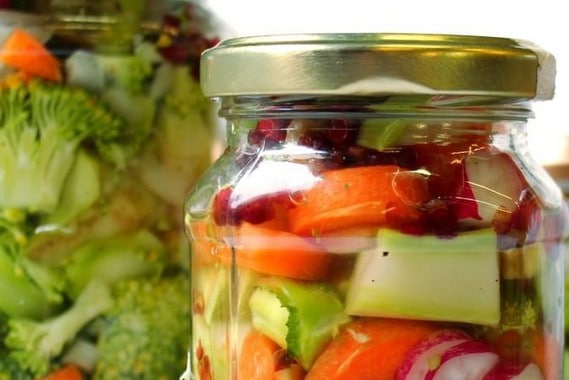

Fermented Root Vegetables
Equipment
- A mixing bowl and a knife (optional)
- Glass jars
Ingredients
- Veggies such as cabbage carrots, beetroot, parsnips, turnips, white radishes
- Sea salt: 1% of the prepared veggies weight
- Aromatics such as garlic onion, parsley, coriander, cinnamon, ginger
Instructions
- Grate or cut veggies into small pieces, or leave them whole if they are small enough.
- Mix veggies, salt and aromatics together. Press mixture with your hand until water emerges.
- Let it rest for 15 minutes until the juice comes out
- Add to jars (including the juice), leaving 1 inch of space at the top. Press firmly to remove any air.
- Seal the jars and put them on a plate. If there is too much juice, you can remove some. Let them ferment at room temperature for at least a week. Don’t open the jars during the fermentation process (to avoid air coming in). The veggies will give away the water and the pots will be full of liquid. After a couple of days, they will be slightly effervescent due to the creation of carbonic gas, removing any air left at the top of the jars.
- You can keep the jars in the fridge or at room temperature for weeks to months. The veggies can be eaten in a salad, or in soup. Don’t salt your meal again; the veggies are already seasoned!
Preserved Lemons
Equipment
- 1 glass jar
Ingredients
- Organic lemon peels use organic as others are heavily treated
- Sea salt
Instructions
- Cut the lemon skins in two or three pieces.
- Place a layer of lemon skins into the jar.
- Add a tablespoon of salt in-between each layer of lemon skins.
- Press well and add more layers until you reach the top of the jar.
- Seal the jar and leave for (at least) a month or two. Can be kept for years!